Table of contents
Current challenges
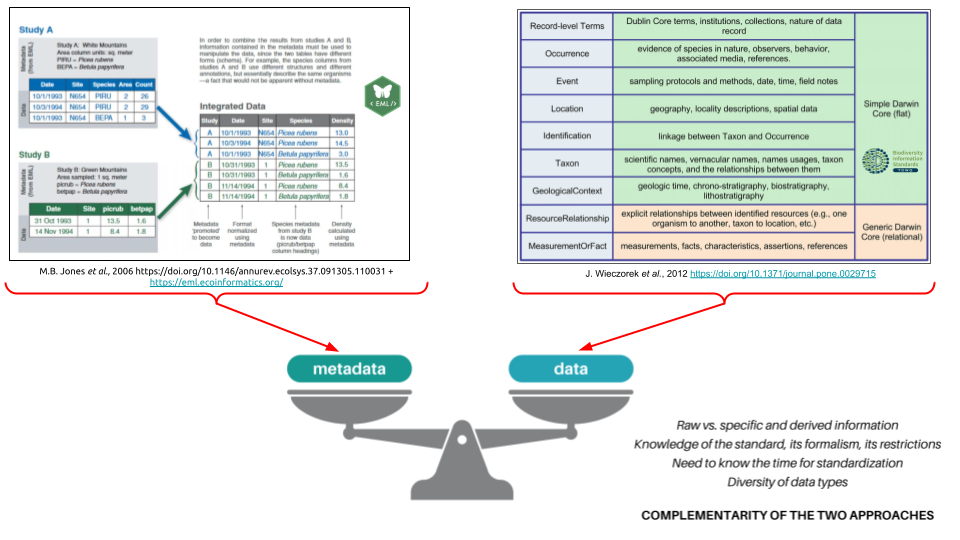
Data and metadata
Data types
Framework and good practices
Heterogeneity and loss of information
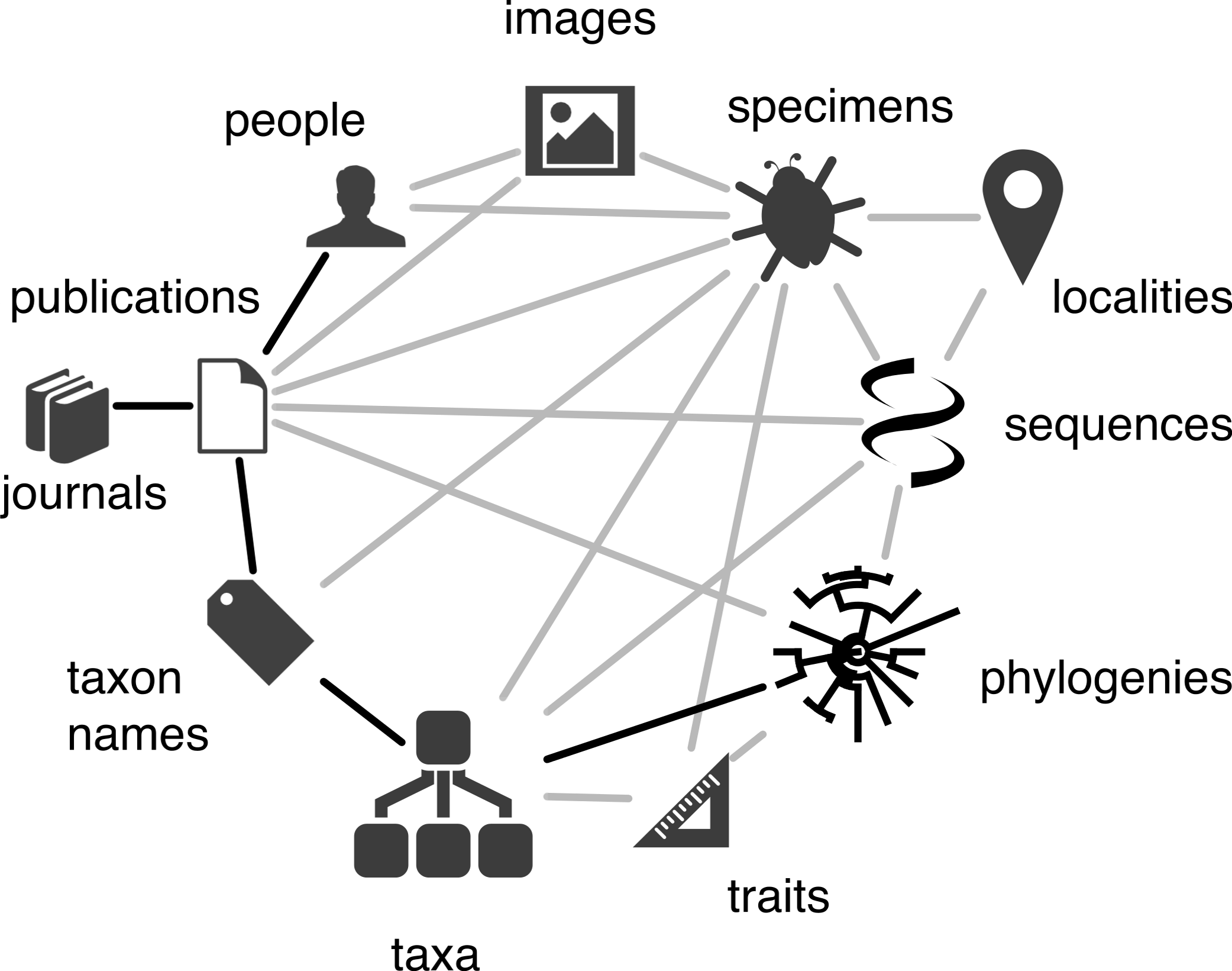
Heterogeneity (data types, origin, standards) &
Diversity of “objects” to be linked together1
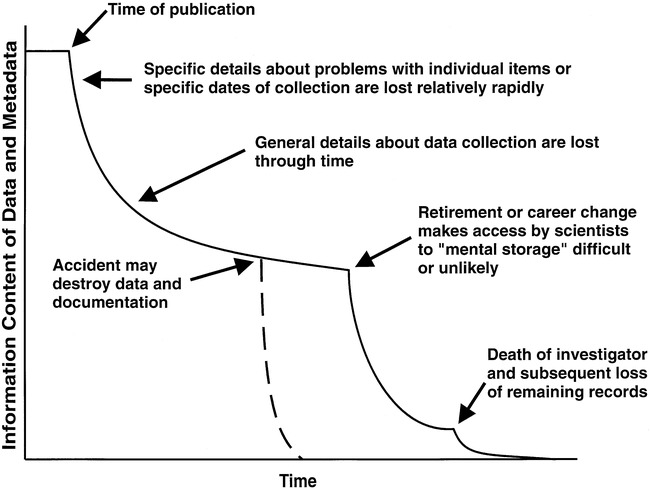
Loss of information over time2
Open Science
Second French Plan for Open Science1
France is committed to ensuring that the results of scientific research are open to all, researchers, companies and citizens, without hindrance, without delay, without payment.
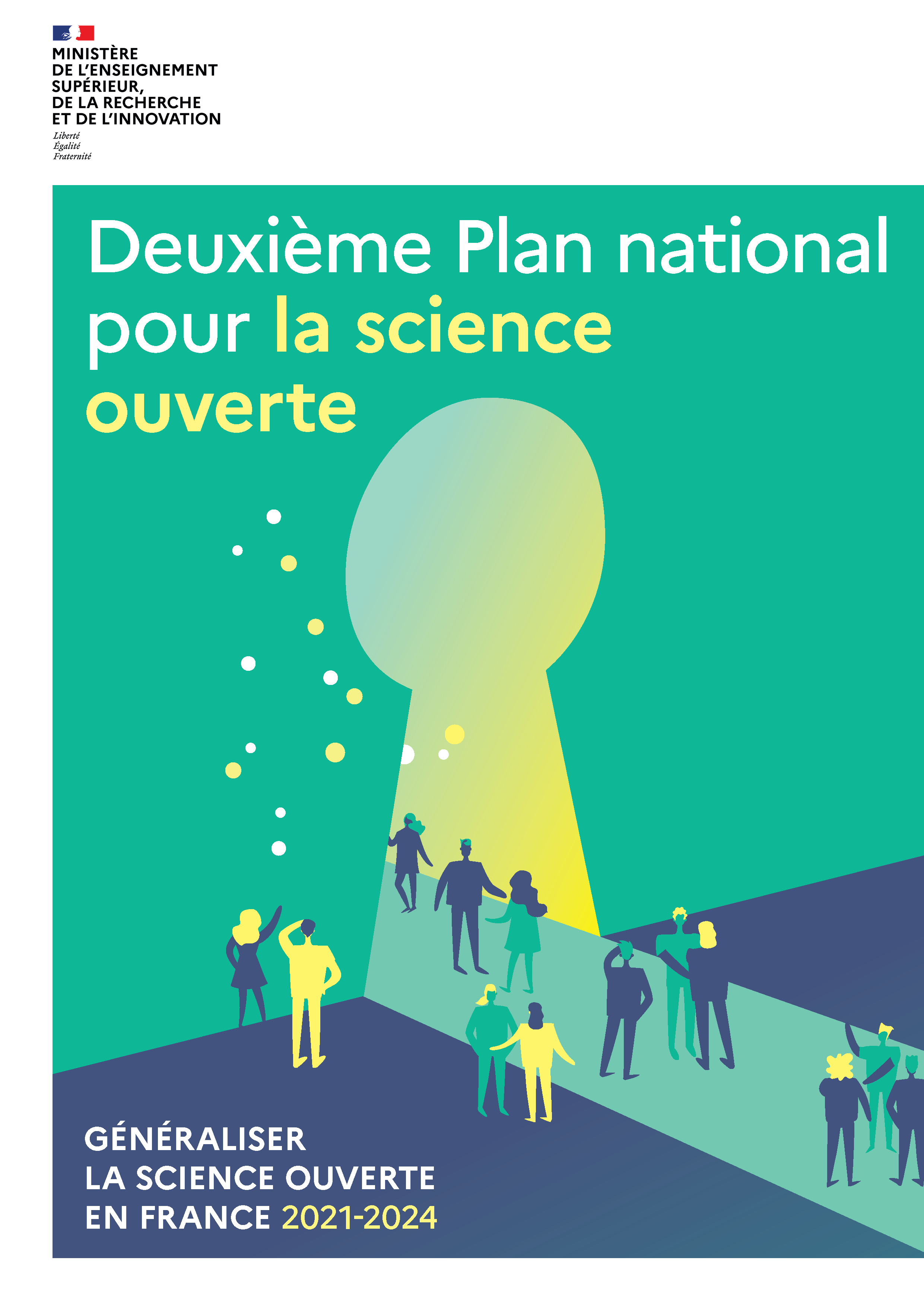
- Axe 1 : Generalize open access to publications
- Axe 2 : Structure, share and open research data
- Axe 3 : Open and promote source codes produced by research
- Axe 4 : Transforming practices to make open science the default principle
Important keywords
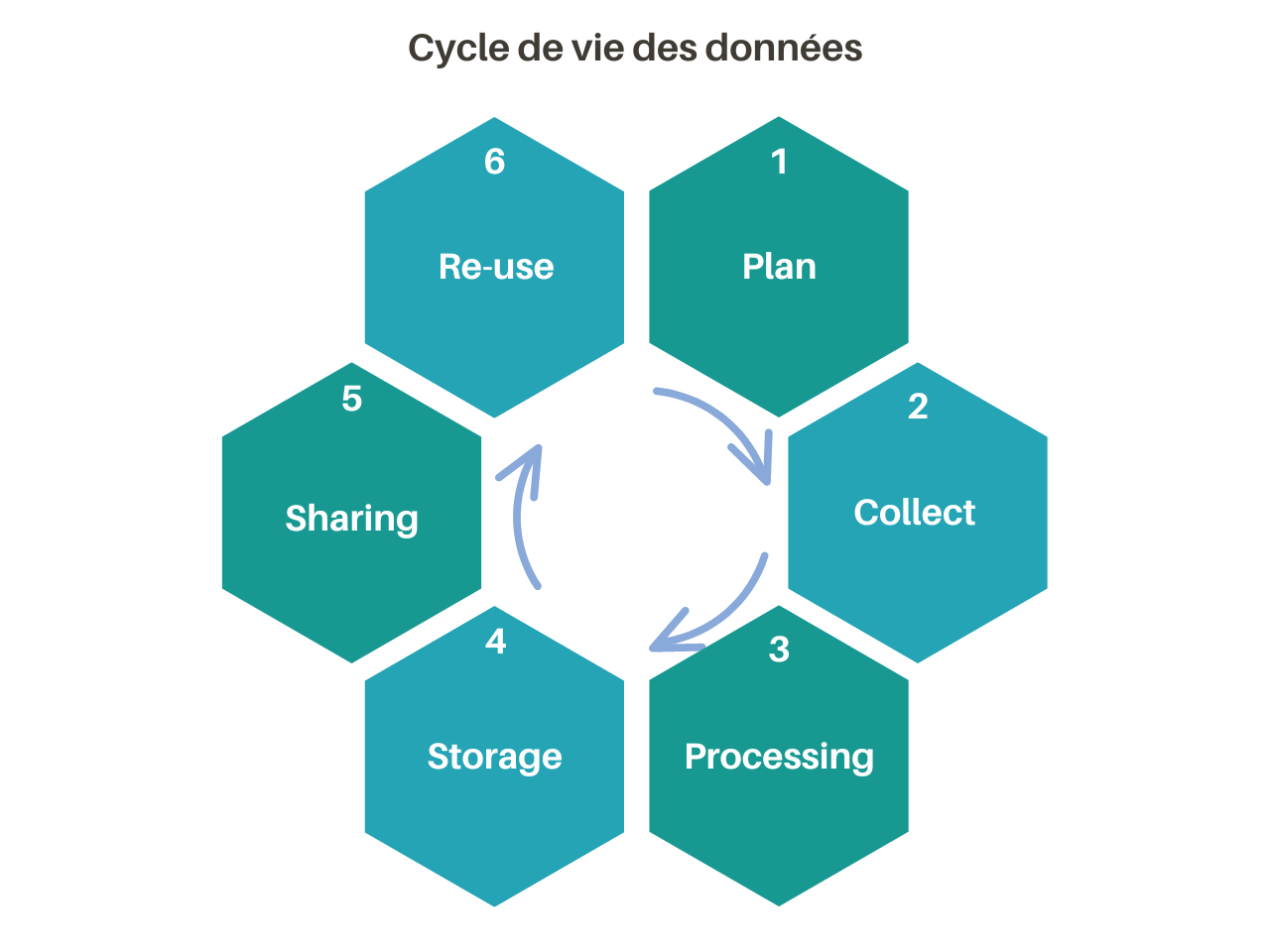
Data life cycle
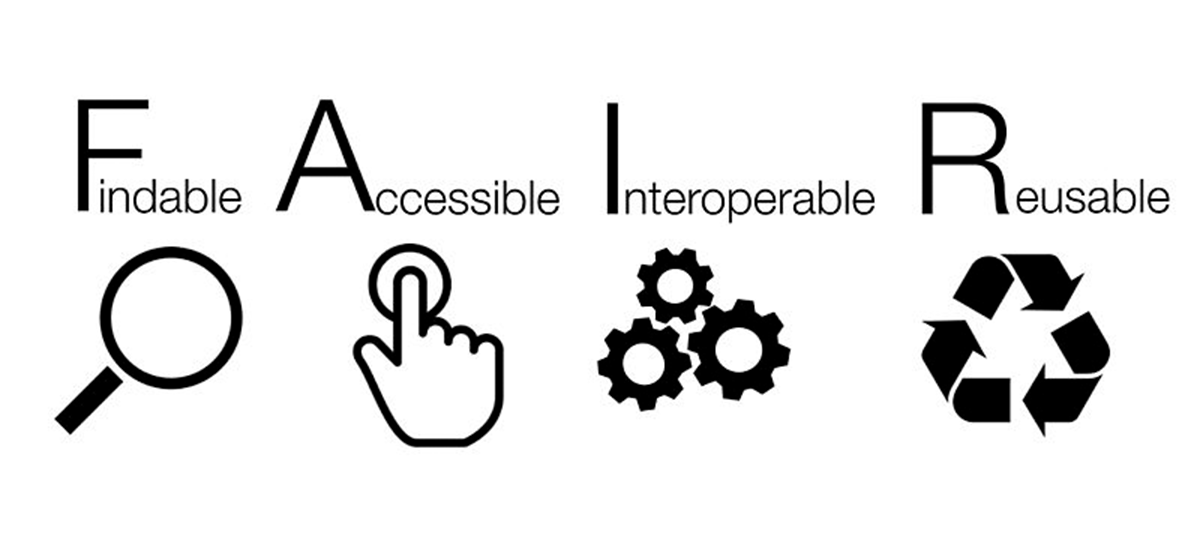
FAIR Principles
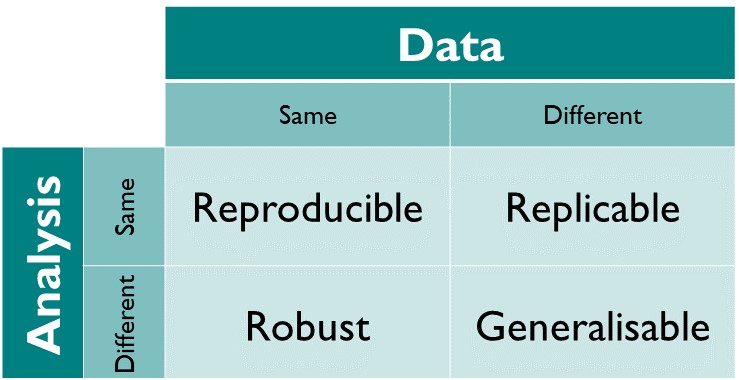
Reproducibility
Flux and stocks of data
Definitions
“Research data are defined as factual records in the form of figures, texts, images and sounds which are used as the main sources for scientific research and which the scientific community generally recognizes as being necessary to validate research results”1.
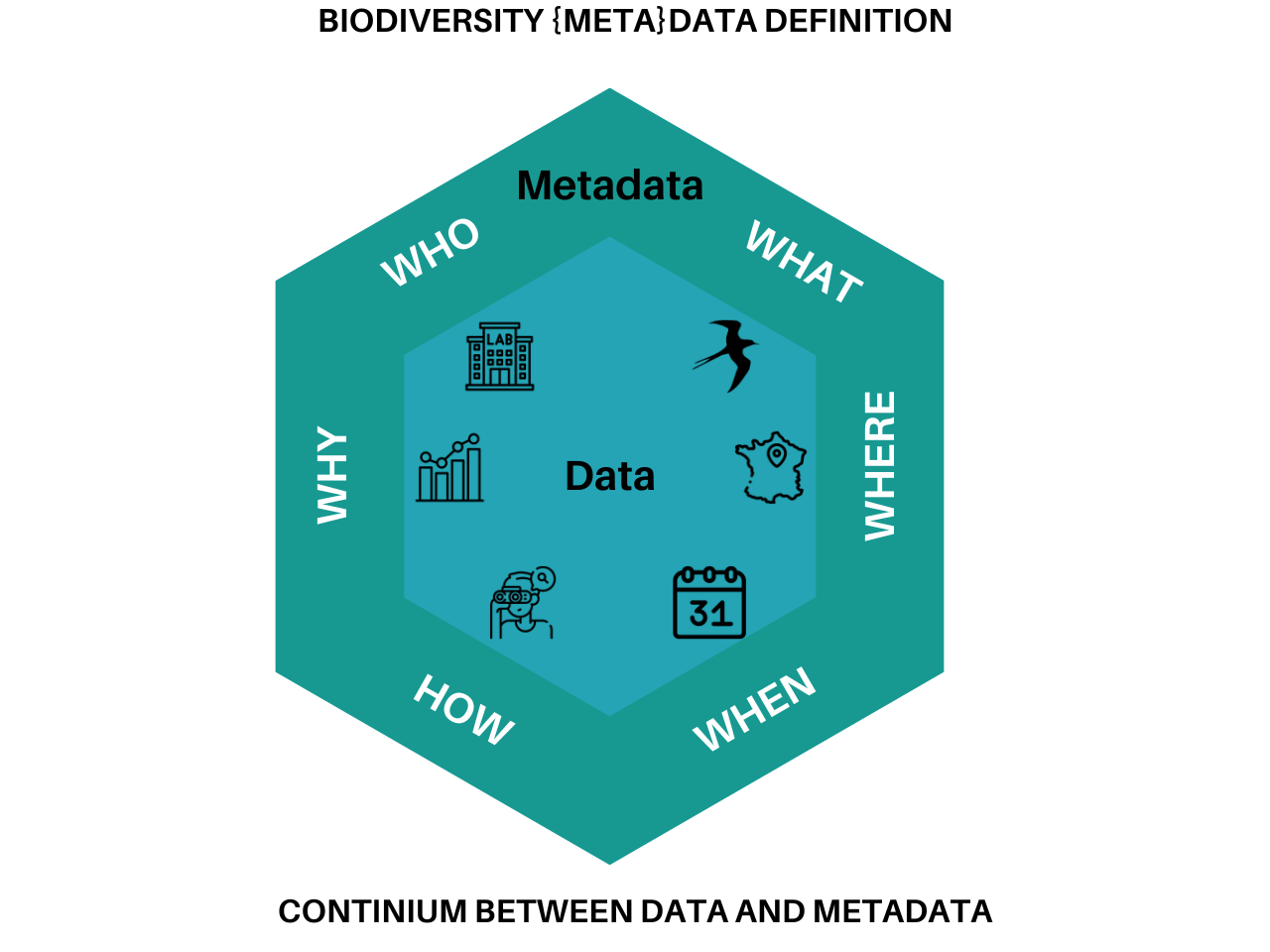
“Metadata, which can be simply defined as “data about data,” is a way of naming things and representing data and their relationships […] Metadata is structured information that describes, explains, locates, or otherwise makes it easier to retrieve, use or manage an information resource”2.
Biodiversity data
Artifacts and symbols collected, stored, and disseminated in order to document the constituent elements of life, extant or extinct, at any scale of time and space.
These elements are biological and encompass anything that contributes to the structure and function of life at any scale, from the microscopic to the level of the planet, and to the continuation of life, that is, its ability to persist and evolve over time.
Data, datasets, databases and co
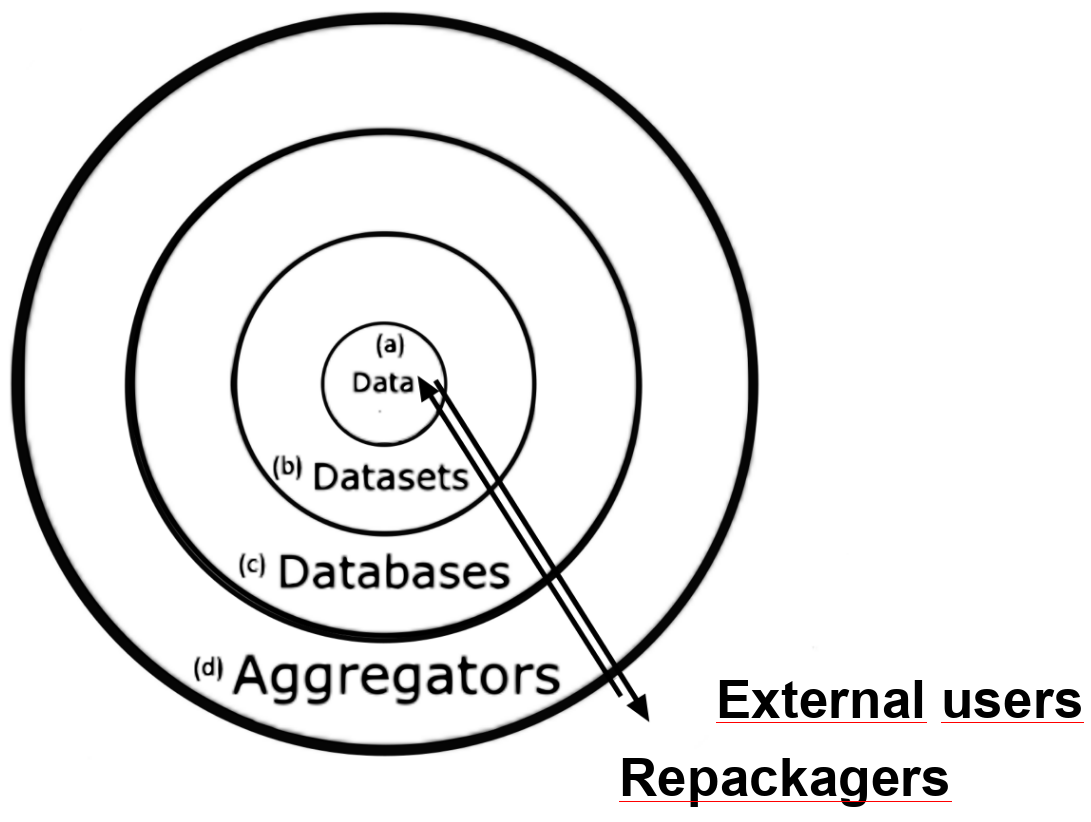
Source: Blair J et al. (2020) https://doi.org/10.3897/BDJ.8.e32765
Legend:
- Data and metadata make up (b) datasets. Multiple datasets in one location form a (c) database. (d) Aggregators compile data from many databases.
Repackagers transform data in a way that makes it more accessible for all audiences. External users (e.g. scientists, industries, government agencies etc.) access raw data by going through any or all of these data sharing portals.
Relational databases
A type of database that stores and provides access to data in tables that can be linked to each through shared columns and rows, called relations, with unique identifiers (keys) that show the different relationships between tables.
Codd’s rules1 :
- Present the data to the user as relations (a presentation in tabular form, i.e. as a collection of tables with each table consisting of a set of rows and columns);
- Provide relational operators to manipulate the data in tabular form.
Tabular datasheets used to be enough to store ecological data. Nowadays, With the increasing amount of biodiversity and environmental data, the use of relational databases is becoming much more frequent.
Characterizing data
Link this information with your biodiversity research projects
Imagine: you’re wondering about the distribution of a given species.
Characterizing data
- what species ? –> observation data: presence/absence, abundance, density, biomass ?
but also: what are the intra-population variations ? DNA, trait measurements ? phylogeny ?
where are they spatially ? in which proportions ?
when were they observed or sampled ? repeated measures ? time stamp or global period ?
how were they collected ? biases ? pseudoreplication ? true absences ?
why and who : citizen science ? opportunistic ? funding ?
Data categories: by format
According to the EML classification1
- Data Table
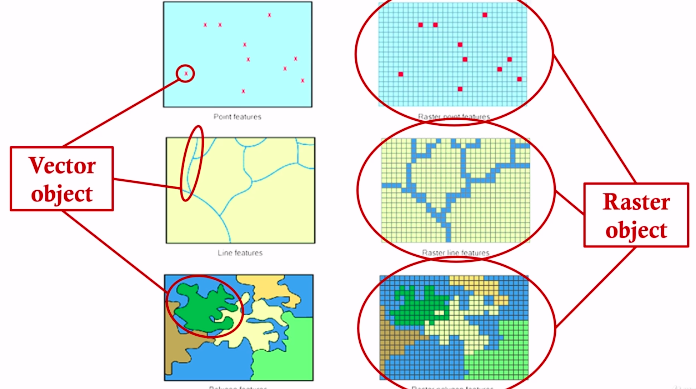
- Spatial raster
- Spatial vector
- Databases
- Other entities
Data categories: by protocols and methods
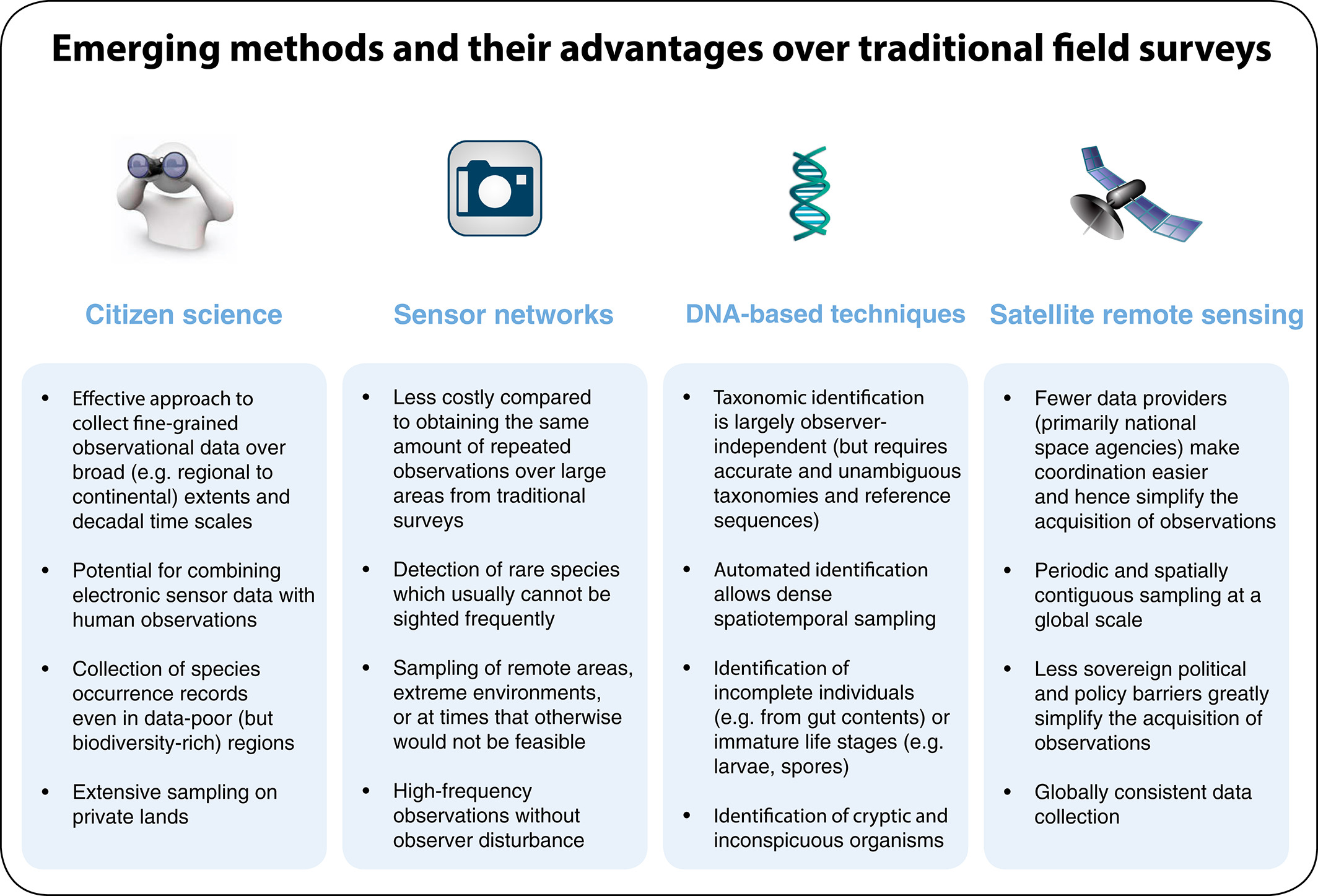
According to Kissling WD et al. (2018)
- Inventories (opportunist vs (semi-)protocole)
- Sensors
- DNA-based techniques
- Satellite remote sensing
- Others (simulated data)
Data categories: thematic and/or “other classifications”
- Longitudinal data
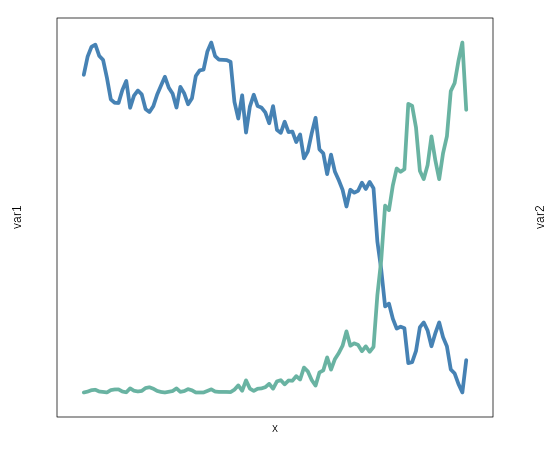
Repeated measures, such as long term surveys, allowing to look at evolution (of abundances, biomass, etc) over time.
Time series analyses
- Spatial data
Generic term that starts whenever there are spatial coordinates (long/lat) associated with an observation. May also refer to remote sensing images, GIS.
- Textual data
Again a very generic term, ranges from spreadsheets of data occurrences to DNA sequences, and text mining (systematic reviews, web scrapping, etc).
Frameworks and Good practices
Data life cycle
FAIR Principles
Reproducibility
Flux and stocks of data
Data life cycle
The data lifecycle is the set of stages of management, conservation and dissemination of research data, associated with research activities.
For more information: PNDB
FAIR principles
A set of guiding principles for managing research data to make it Findable, Accessible, Interoperable, and Reusable by humans and machines1.
This is the way!

For more information: PNDB
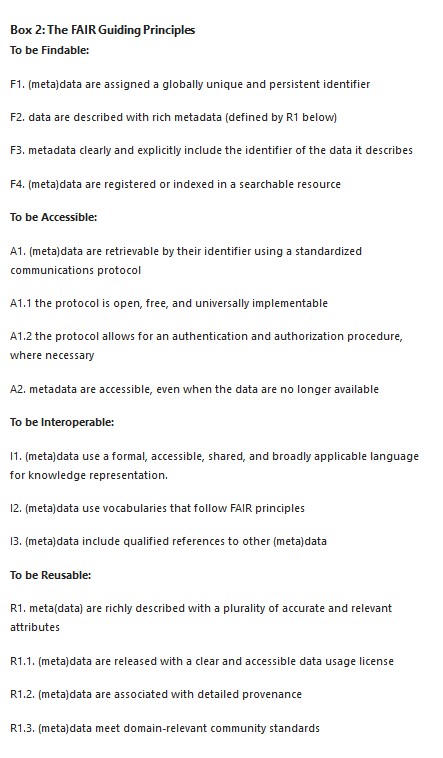
FAIR principles
What is reproducibility?
Reproducibility is about results that can be obtained by someone else (or you in the future) given the same data and the same code. This is a technical problem.
We talk about Computational reproducibility
What is reproducibility?
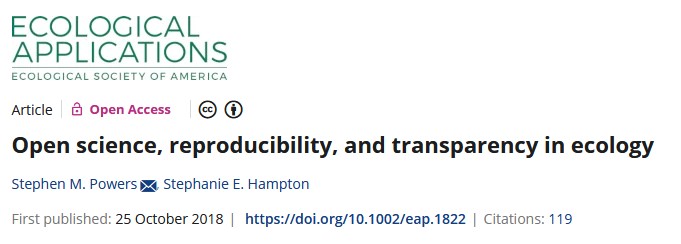
Computational reproducibility frequently refers to the ability to generate equivalent analytical outcomes from the same data set using the same code and software1.
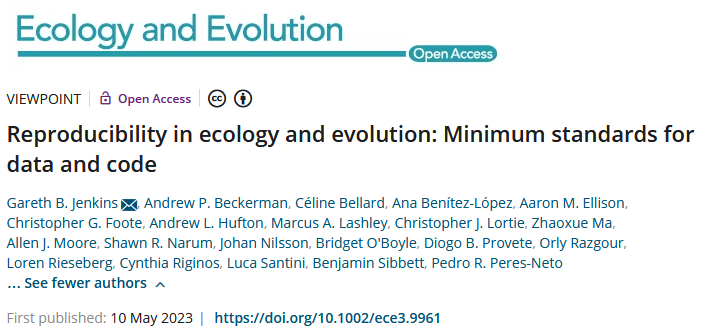
[…] all raw data and metadata, code, programming scripts, and bespoke software necessary for fully replicating any analyses that lead to inferences made in a published study2.
Reproducibility spectrum
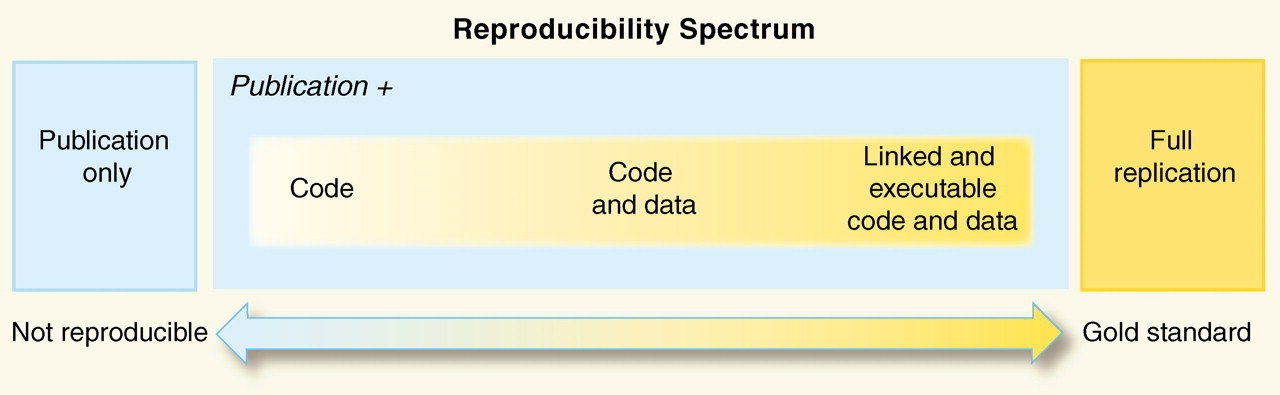
Each degree of reproducibility requires additional skills and time. While some of those skills (e.g. literal programming, version control, setting up environments) pay off in the long run, they can require a high up-front investment.
Tools
Website available at: https://rdatatoolbox.github.io/
Flux and stocks
Flux and stocks
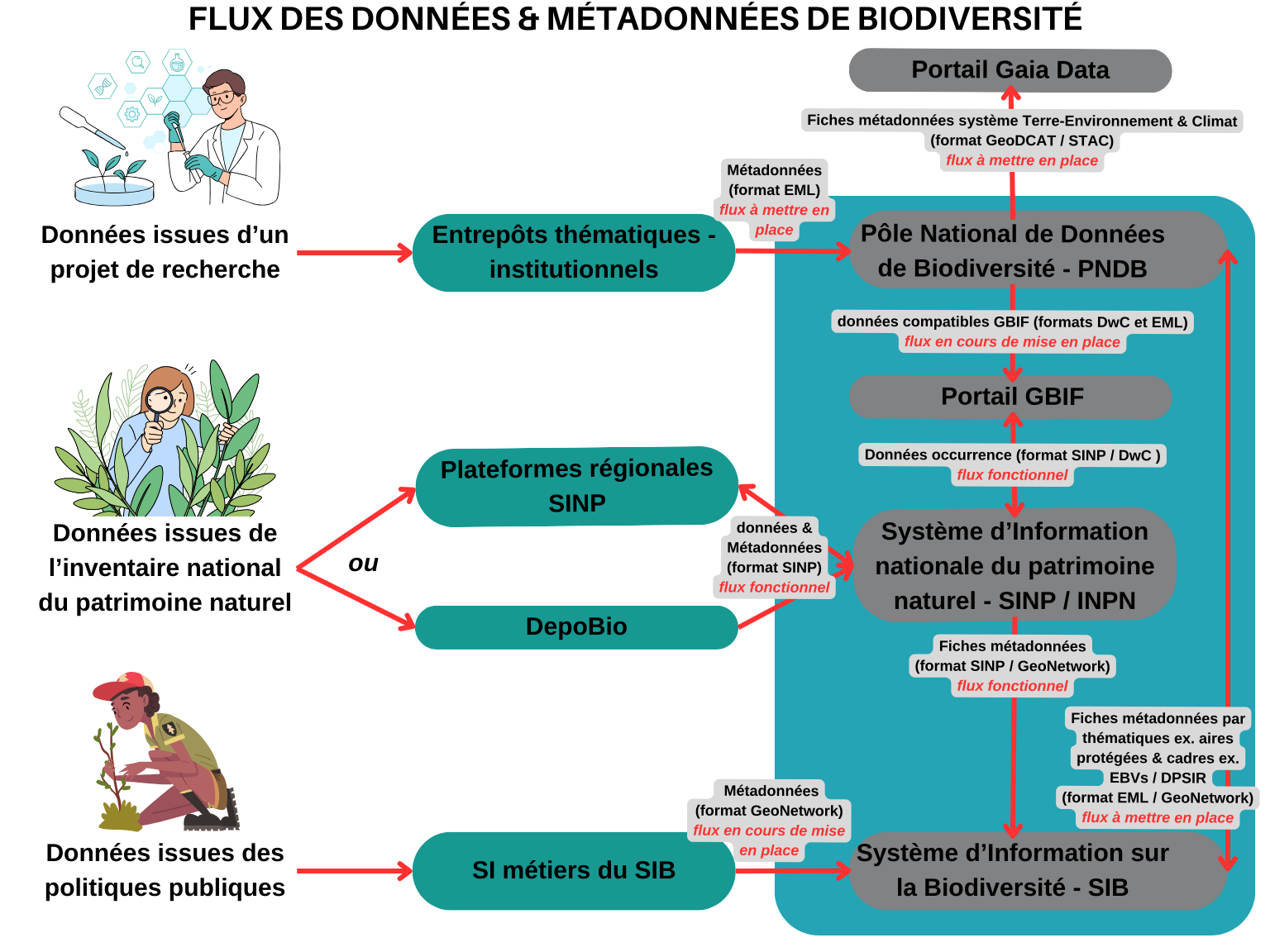
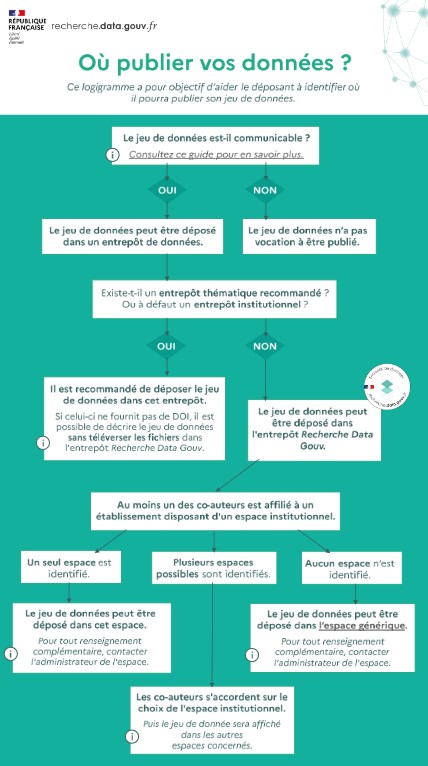
Sharing data and metadata from research activities requires making them available in repositories.
It is recommended to prioritize deposits in trusted thematic repositories (eg. InDoRES, SEANOE, …), or failing that in institutional repositories (eg. Data SUD, CIRAD Dataverse, …), or failing that, in generic repositories such as the Recherche Data Gouv repository. Resources exist for choosing the adapted and recommended data repository.
A complex landscape
- Diversity of tools and practices (historical practices)
- Different supervisions
- Flow and storage of data and metadata
- Difficulty for data producers to identify the right information systems to deposit their data according to the scopes and themes
- Difficulty for users to know where and how to search for data
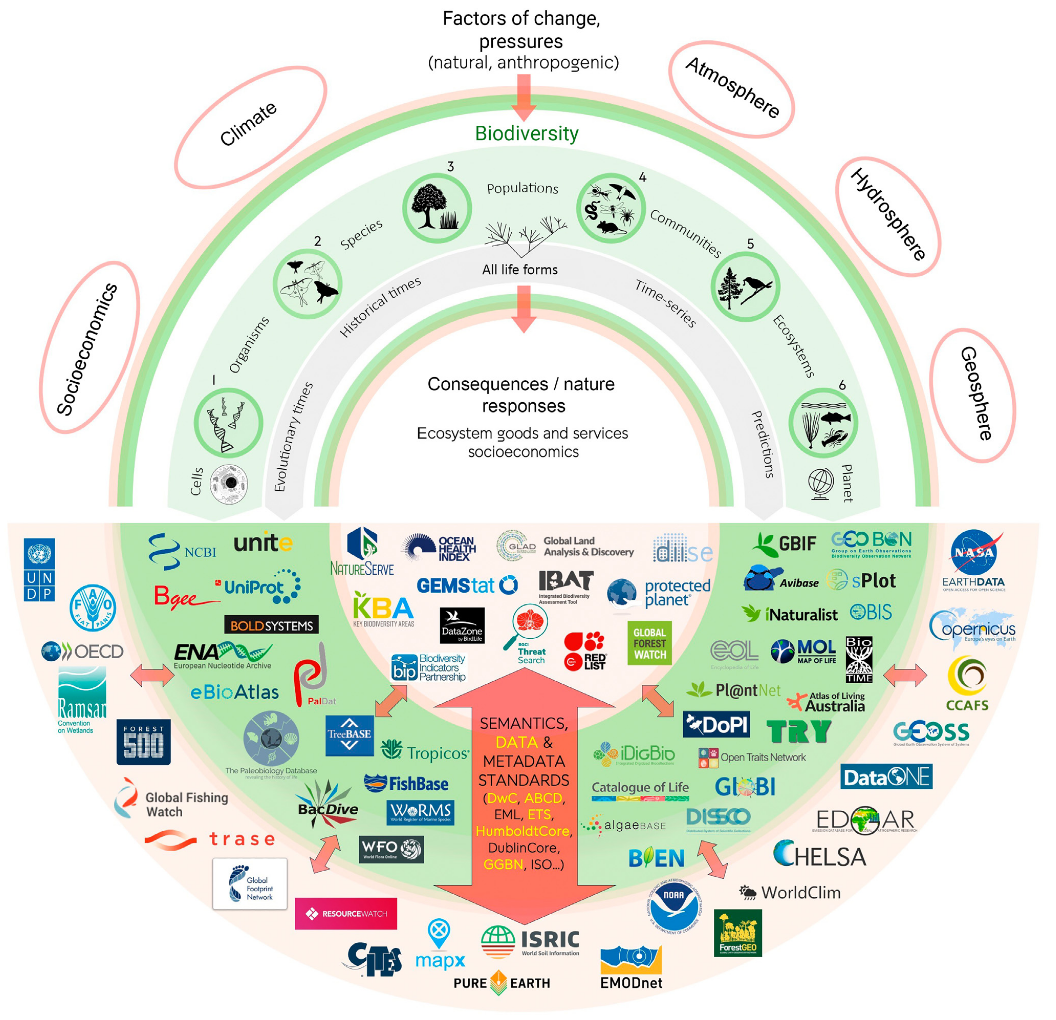
Figure from Garnier & Pavoine et al.,2025
A complex landscape
PatriNat wrote a document (in french) to support producers and reusers of biodiversity data and metadata in:
- Understanding the landscape (actors, who does what, who is who, etc.)
- Sharing (meta)data (where to deposit them, what types of data, etc.)
- Using the latter via information systems according to the themes and/or target audiences
The targets of this document are mainly researchers, managers, engineers and data technicians
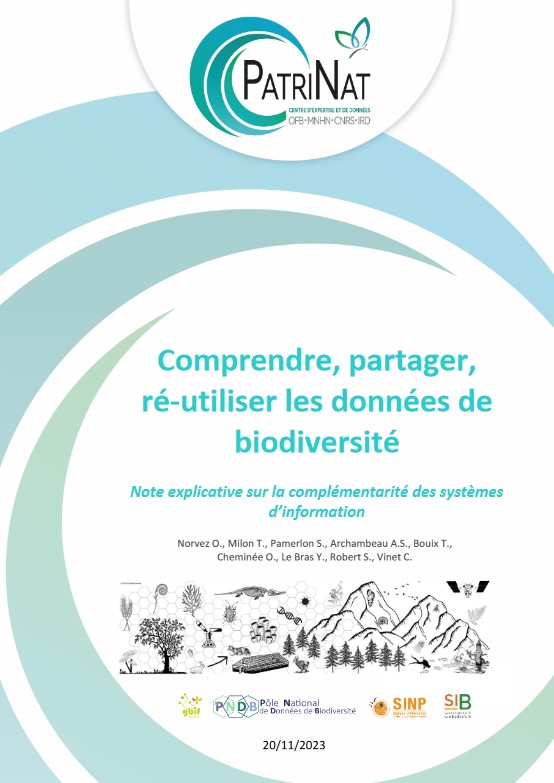
- Version 1 is available here
- Version 2 will be available soon in January 2025
A complex landscape
A complex landscape
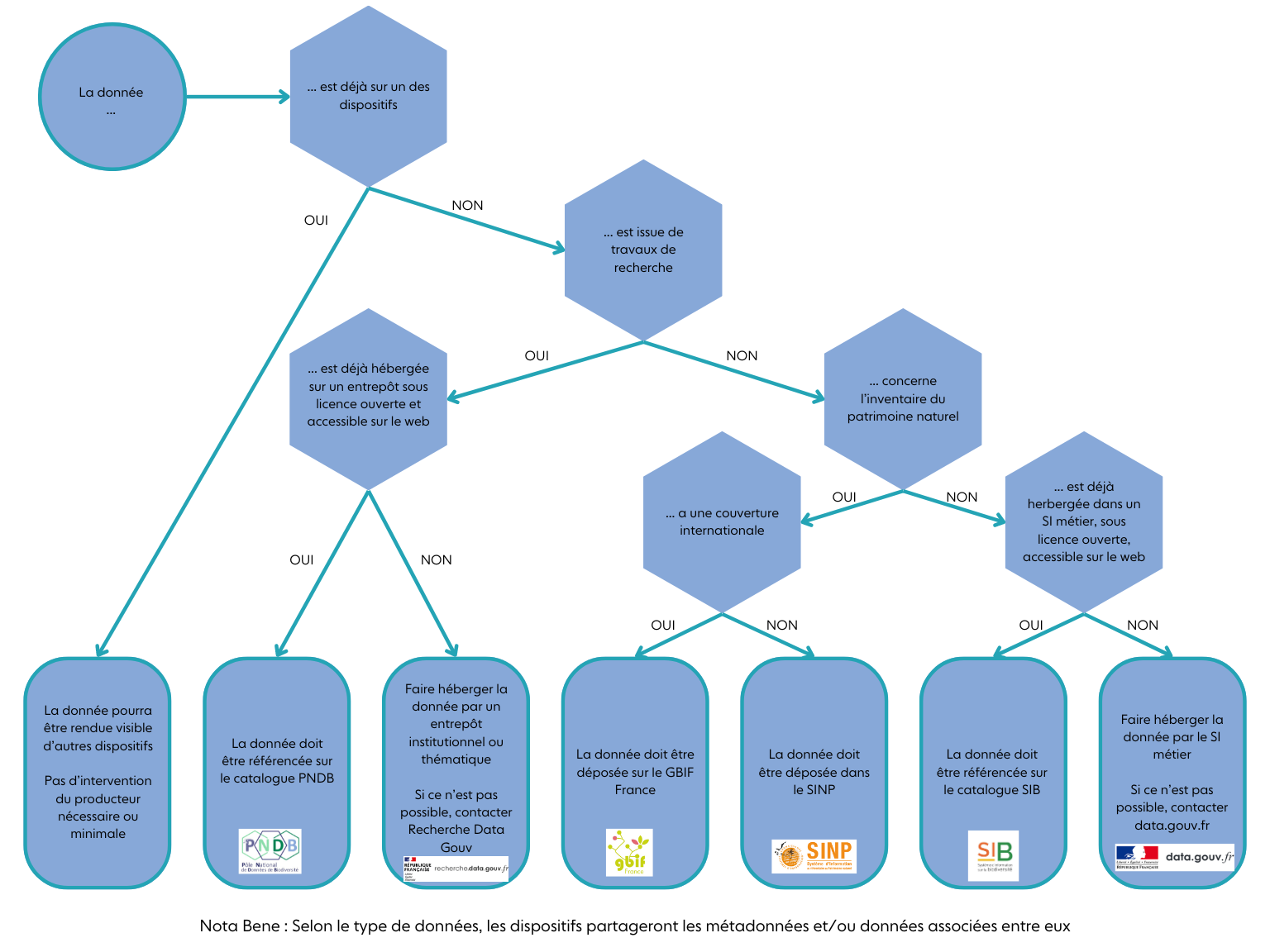
Take home message
- Heterogeneity (data types, origin, standards) & diversity of “objects” to be linked together1
- Loss of information over time2
- Toward a better open science and reproducibility 3 4
Resources
Data Terra